ALGAL EVOLUTION
| While we will take a very traditional approach in this course to our brief survey of the algae, be aware that our understanding of how the algae evolved is currently undergoing revolutionary change. All of this is a result of the realisation that the story of algal evolution is tied to how they acquired their photosynthetric organelles or plastids. The first plants evolved from the engulfing of a photosynthetic prokaryote by an aerobic eukaryote. From this initial event two major plant groups evolved - the Green Algae and the Red Algae. |  |
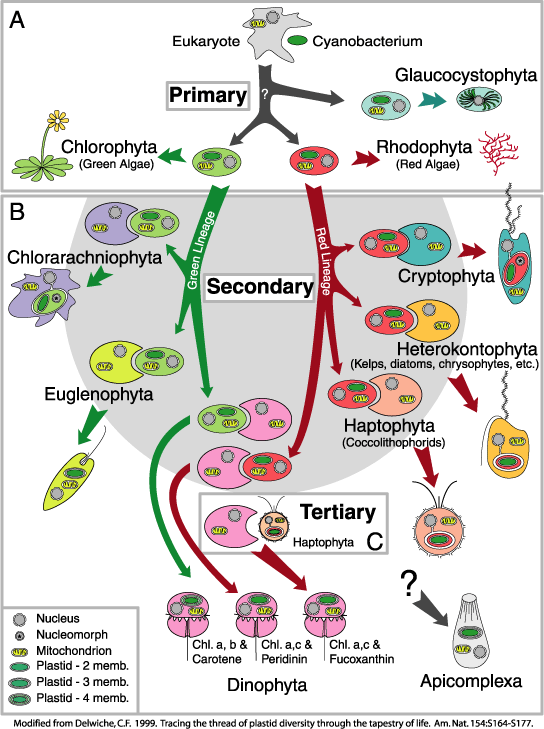
| After this primary endosymbiotic union, secondary and even tertiary endosymbioses occurred - algal cells themselves getting engulfed to give rise to other algal groups. We will not delve into the details of this in this introductory course but you can get a flavour for this in the figure below. |  |
| Diagrams courtesy of John Archibald |
| From that primary endosymbiosis, 3
groups, green algae, red algae and glauco(cysto)phytes emerged. (The
glaucophytes are a minor group of freshwater algae which still retain a
peptidoglycan cell wall around their plastid.). All other "algal" groups came later, getting their plastids second hand... Euglenids evolved by the ingestion of a green alga (and have 3 instead of 2 outer plastid membranes)! Heterokonts (brown algae, chrysophytes incl. diatoms), a monophyletic linkage all having tripartite hairs on their flagella, arose by a a secondary endosymbiosis of a red alga.Their plastids have 4 outer membranes. Most dinoflagellates have plastids of the red lineage with 3 outer membranes. |
 |
| Analysis of plastid structure, photosynthetic pigments, nuclear, plastid and mitochondrial gene sequences have all helped to construct this picture. In this endosymbiosis, the genes for most plastid proteins were transferred to the nucleus but this meant these proteins made in the cytoplasm had to be targetted to the plastid. The sequences for addressing these have been particularly useful in this story. |
Diagram courtesy of John
Archibald
|
Click here for a great figure on algal evolution modified from
Delwiche (1999) Tracing the web of plastid diversity through the tapestry of life. American Naturalist 154:S164-S177.
Delwiche (1999) Tracing the web of plastid diversity through the tapestry of life. American Naturalist 154:S164-S177.
For further information see
McFadden, GI (2001) Primary & secondary endosymbiosis and the origin of plastids"
J. Phycol. 37: 951-959.
McFadden, GI (2001) Primary & secondary endosymbiosis and the origin of plastids"
J. Phycol. 37: 951-959.
 |
Return to looking at other major groups of Algae. |